The SOC's real bottleneck was never the alerts. It was attention.
For two decades the answer to alert overload was the same: more dashboards, more analysts, more playbooks. None of it changed the actual unit of work. Agentic security finally does, and it is why we partnered with 7AI.

Walk into any security operations center and you will find very smart people doing work that does not require their intelligence. An alert fires. Someone opens it, checks a few systems, decides it is noise, closes it, and reaches for the next one. Repeat a few thousand times a day. The talent is real. The work is mechanical.
This is the quiet truth about the modern SOC. It was never primarily an alert problem or a tooling problem. It was an attention problem. There is a finite amount of skilled human attention available on any given shift, and the volume of things demanding that attention grew far faster than the supply of people who could give it. Everything the industry built over the last twenty years was an attempt to manage that gap without ever closing it.
We kept scaling the wrong thing
The first answer was the SIEM. Ingest everything, centralize it, and let analysts query it. Useful, but it turned a visibility problem into a volume problem. Now every signal landed in one place, and a person still had to read them one at a time.
The second answer was SOAR, security orchestration and automated response. This was supposed to be the automation layer that saved the analyst. In practice it automated the easy part and left the hard part untouched. SOAR runs pre-written playbooks: an alert matches a known pattern, the platform runs the response that was scripted for that pattern. It is genuinely good at the threats you already understood well enough to write a rule for. The problem is that those were never the threats keeping anyone up at night.
Playbook matching
An alert is compared against a library of scripted responses. If it matches a known pattern, the platform executes. Anything novel or ambiguous falls back to a human queue. You automated the 20 percent you already understood.
Dynamic reasoning
An agent investigates the alert itself: it gathers context, weighs evidence, and reasons toward a conclusion. It can work a threat it has never seen because it is reasoning, not pattern matching. The hard 80 percent becomes addressable.
That distinction is the whole story, so it is worth saying plainly. A playbook can only respond to a situation someone anticipated. A reasoning agent can respond to a situation no one anticipated, because it is doing the same thing your best analyst does: looking at the evidence and thinking about what it means. That is not a faster playbook. It is a different category of system.
Not a chatbot bolted onto a dashboard
The word agentic gets used loosely, so here is the concrete version. When an alert fires, a 7AI agent does not hand a human a summary and wait. It begins an investigation. It pulls context across the environment that matters for that alert: cloud, endpoint, identity, network, email, and data loss telemetry. It correlates what it finds, traces the attack path, and reasons about the whole picture against your organization's policy and risk tolerance. When new information changes the picture, it re-evaluates, consistently, without fatigue and without skipping steps because it is the fourth hour of a night shift.
The output is not a longer alert. It is a finished investigation. Most of the time the conclusion is that the alert was a false positive, and the agent closes it with a documented trail of how it reached that call. When the conclusion is that something real is happening, it assembles the full investigation package and either executes a policy-driven response inside your guardrails, isolating a resource, revoking a credential, blocking traffic, or escalates to a human with the work already done.
In the legacy path, a playbook can only auto-handle alerts that match a pattern someone scripted in advance. Everything novel or ambiguous funnels to a human reading one item at a time, which is the real bottleneck. The agentic loop runs the investigation itself, then resolves or responds autonomously inside your guardrails, and reserves people for the cases that genuinely need judgment.
This is not about removing people
The reflexive worry is that autonomous investigation means fewer analysts. The more accurate framing is that it removes the mechanical work analysts never wanted to be doing. When the triage queue is handled, your team is freed for the work that genuinely needs a human: threat hunting, novel attacks, coordinating response across business units, and improving posture so the same incident does not recur. 7AI pairs the platform with dedicated engineers who tune the agents to each environment's detection rules and escalation policy, which is what keeps the autonomy aligned to how a given organization actually defines risk.
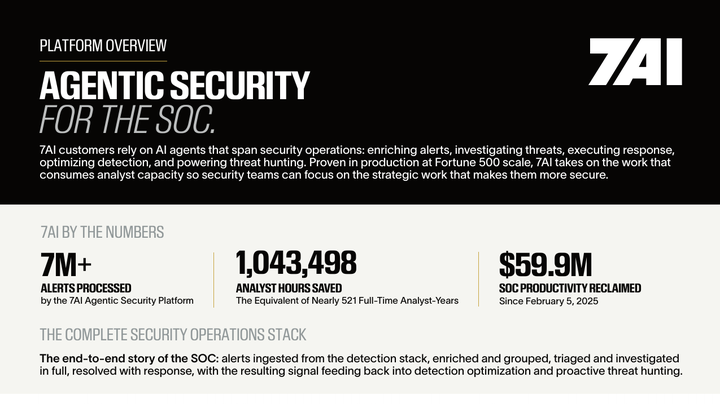
The numbers 7AI reports from production deployments are the kind that change a staffing model rather than a line item. The company cites false positive reductions in the range of 95 to 99 percent and tier-one analyst time cut by roughly 80 percent, with one large managed-services partner standing up what it described as the largest agentic security operation of its kind in a matter of weeks. Treat vendor figures as vendor figures, but the direction is not in dispute, and the architecture is why the direction holds.
A playbook can only answer a question someone already asked. A reasoning agent can answer the question that just walked in the door.
The real question for a CISO
The wrong way to evaluate this is as another box in the stack. 7AI connects to the tools you already run through their APIs, so there is no rip and replace, and it is built to sit natively alongside cloud-native security, ingesting and acting on findings from services like AWS Security Hub and GuardDuty. The deployment question is measured in weeks, not quarters.
So the question is not whether you need another security product. It is what your analysts' attention is worth, and whether you want to keep spending it on a queue that a reasoning system can clear. Framed that way, the decision stops being technical and becomes economic, which is usually where the most important security decisions actually live.
Why we brought 7AI to the table
We spend our time on this category because the shift from playbook to reasoning is one of the clearer inflection points in enterprise security right now, and most teams have not fully priced it in yet. We brought 7AI to our customers because we are convinced the agentic SOC is where security operations are heading, and we would rather you hear that from us a year early than read it in an analyst report a year late. Having a real point of view on where the technology is going, and being willing to stake it, is what we think a partner is actually for.