
The first wave of AI coding made engineers faster. The next wave changes what an engineer does.
Factory just raised $150 million at a $1.5 billion valuation for autonomous agents that run the entire software lifecycle, not autocomplete in the editor. Most enterprises have not evaluated it yet. That gap is exactly why it is on our radar, and why it should be on yours.

From autocomplete to autonomy
For most of the last two years, AI in software meant an assistant in the editor. It waited for an engineer to type and offered the next few lines. Useful, and now widely adopted. But it left the shape of the work untouched. The engineer still owned every step.
Factory starts from a different premise. Its Droids own the parts of engineering that do not require human judgment: testing, debugging, refactoring, migrations, code review, and documentation. An engineer hands off an objective and the Droid executes across the codebase, then returns with a pull request a human can approve. The framing is that engineers should live in the outer loop, reasoning about requirements, architecture, and customers, while agents handle the inner loop of writing, testing, and building. The point is not to type faster. It is to move the human up a level.
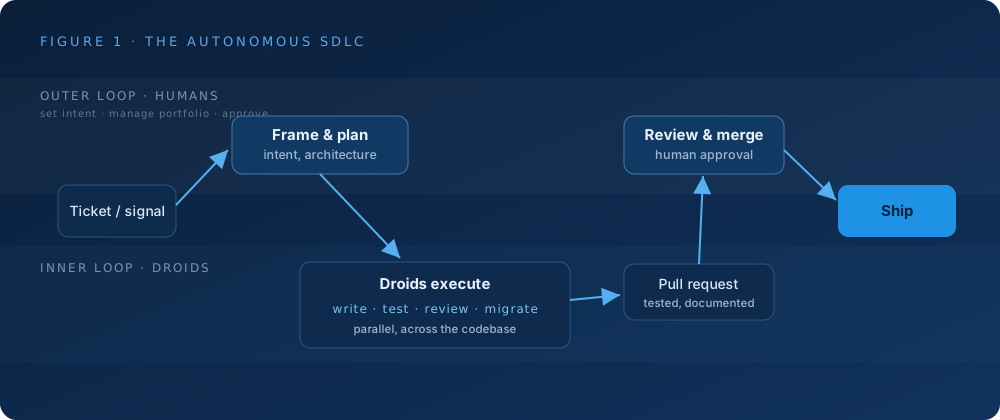
The human moves up a level. Agents own the inner loop, people own intent and approval.
What Factory actually built
Three things separate Factory from a chat window bolted onto an editor.
First, it runs where engineering already happens, not only in the IDE. Droids operate from the command line, inside Slack and Microsoft Teams, as a GitHub application, and against project tools like Jira and Linear. They pull context from the systems a team already uses, including GitHub, Notion, and Sentry, so the agent works from the same memory the team has rather than a blank slate.
Second, it handles work that is too large for a single agent session. Factory's Missions break a big task into focused units with separate roles, an orchestrator that plans, workers that implement, and validators that check the result, with tests written before the code. That structure lets the system run complex work over hours or days without drifting, which is the failure mode most agents hit on real codebases.
Third, it is built to persist. Droid Computers give each agent a durable machine, in Factory's cloud or on the customer's own hardware, so long running and local work has somewhere to live. The result is less a coding tool and more an operating layer for an engineering organization.
The moat is the environment, not the agent
The most useful thing Factory's founders say is also the least flattering to the hype. Their view is that the agent is not the hard part. The hard part is the environment it runs in. CEO Matan Grinberg has compared a coding agent to a sports car dropped into a city with dirt roads. The problem is rarely the car. It is the roads. In an enterprise, the roads are documentation, test coverage, CI/CD, observability, and the knowledge that lives in senior engineers' heads and never gets written down.
The enemy of agents is tacit knowledge.Matan Grinberg, CEO, Factory
That belief is the moat, because it aims the product at the durable problem. Factory instruments the whole lifecycle so the system learns from every session, review, and resolved incident, and that learning compounds inside the customer's own walls. The company designed for sovereignty from the start, with hosted, bring-your-own-key, self-hosted, and fully air-gapped options, plus SOC 2 and ISO 42001 compliance, which is what regulated buyers in finance, healthcare, and government require before anything reaches production.
It is also deliberately model-agnostic. Droids route each task to whichever foundation model fits, whether that is Claude, GPT, Gemini, or an open model running on-prem for sensitive work. The customer is not locked to one lab, and confidential code can go to a private model when it matters. Factory is positioning itself as the orchestration layer for autonomous engineering rather than a single-model product, and that orchestration is harder to replicate than any one agent.
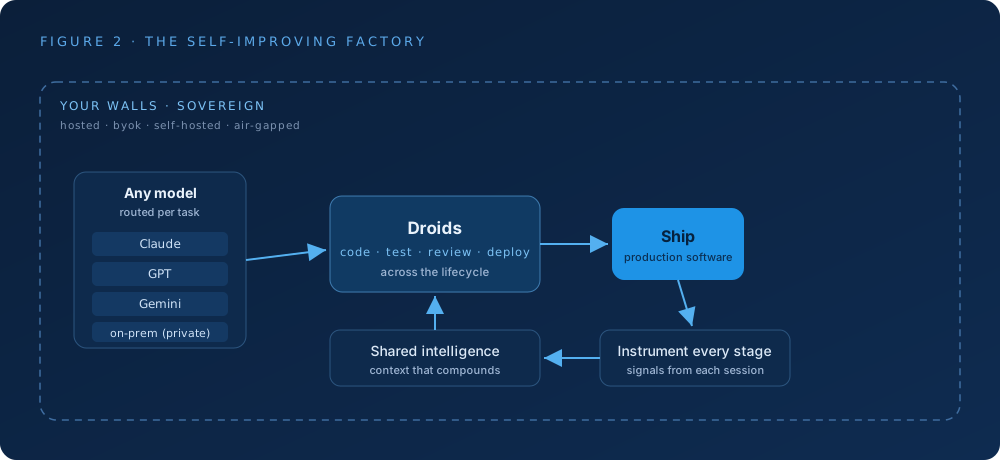
Every stage instrumented. The system learns from each session and that capability stays inside your walls.
Why this matters now
The timing is not subtle. In April 2026 Factory raised $150 million at a $1.5 billion valuation, in a round led by Khosla Ventures with Sequoia Capital, Insight Partners, and Blackstone, bringing total funding to roughly $220 million. The company says revenue has doubled month over month for six straight months, and that hundreds of thousands of developers now use Droids daily at enterprises including Nvidia, Adobe, Ernst & Young, Palo Alto Networks, and MongoDB.
Those are not pilot logos. They are some of the most demanding engineering organizations in the world, which tells you the product survives contact with real codebases and real compliance teams. The broader market is moving the same direction, from experimenting with coding assistants to signing serious contracts for autonomous engineering. The advantage of acting now is structural. Because Factory's system improves the longer it runs inside your environment, the teams that start earlier compound that lead. Waiting until it is obvious means starting the clock late.
We bring a company forward when three things are true at once: the category is real, the team is among the best executing on it, and the buyer still holds an early-mover edge. Factory clears all three.
If autonomous engineering is on your roadmap in the next twelve months, this is a name to evaluate now, while adoption is still a decision and not yet a default. What we are watching: how quickly the model-agnostic orchestration advantage widens as more of the lifecycle runs on a single platform.
Why we are bringing it to you first
Ghost does not exist to resell the tools you have already shortlisted. Anyone can do that, and the value is thin. Our work sits upstream of that. We spend our time identifying the companies that are about to define a category, and we bring them to you before they appear in an analyst quadrant and before another reseller mentions the name.
Factory is a clear example. It is early enough that most buyers have not evaluated it, and strong enough that the most serious engineering teams already have. We think the agentic shift in software will run through companies built like this one. When you are ready to move, we make the path from interest to deployment simple. But the part that matters most happens earlier: getting the right company in front of you while it is still an edge, before it becomes the default.